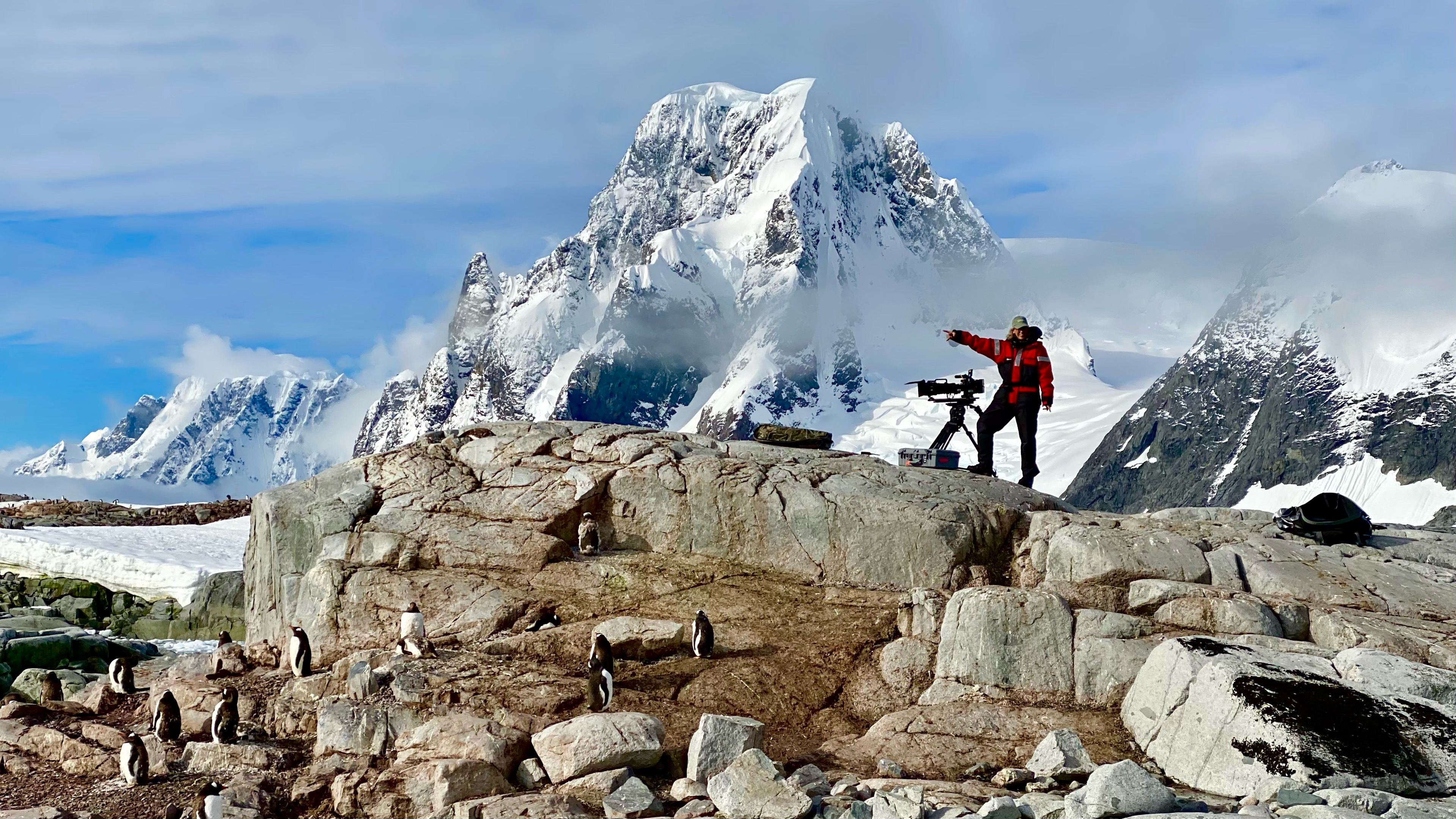
Gentoo penguins & Sophie Darlington on location in Antarctica. Photo courtesy of Netflix/Bertie Gregory
Sophie grew up in England, Ireland and Iran being dragged on walks by brothers and devouring books about animals…
Sophie’s passion for the natural world began during a childhood spent between England, Ireland and Iran, where she was constantly dragged on wilderness walks by her brothers and devoured books about animals.
In 1986, inspired by Peter Matthiessen’s The Tree Where Man Was Born, Sophie left Ireland for Tanzania. At 19, she arrived at Gibb’s Farm Safari Lodge on the edge of the Ngorongoro Highlands, where she met Hugh Miles and Keith Scholey of the BBC Natural History Unit. Their passion for wildlife filmmaking opened up a new possibility: perhaps she could make a life behind a camera, telling stories about the natural world.
Four years later, Sophie was introduced to the legendary eight-time Emmy Award-winning wildlife filmmaker Baron Hugo van Lawick by Aadje Geertsema of Ndutu Safari Lodge. Hugo was looking for a camp manager and sound recordist; as it turned out, he was also willing to take on an apprentice cinematographer. Sophie spent several formative years learning under his watchful eye in the Serengeti National Park.
That apprenticeship shaped the filmmaker she would become.
At a time when there were very few women working in wildlife cinematography, Sophie went on to build a career spanning more than three decades as a UK-based wildlife videographer and cinematographer. She is known for capturing intimate and emotionally powerful animal behaviour and landscapes, using beauty, light and observation as a way into the story. Her work combines a deep understanding of animal behaviour with an instinct for those powerful moments that reveal character and emotion. Long lens is her particular strength, but she's equally at home with high-speed, infrared and thermal cinematography, set lighting, and pretty much any camera a production throws at her.
She was Series Director of Photography on National Geographic's Lion (2026), following the extraordinary journey of a male lion from cubhood towards adulthood. She was also one of the Series Directors of Photography, alongside Justine Evans, on National Geographic's Queens (2024), a series exploring female leadership in the natural world.
Her credits span feature films for Disneynature and BBC Earth, as well as landmark natural-history series for Netflix, National Geographic and the BBC, including Dynasties I & II, Our Planet I & II, The Hunt, Planet Earth II and Life Story, many narrated by Sir David Attenborough.
In 2016, Sophie was part of the cinematography team awarded the BAFTA for Photography: Factual for The Hunt. In 2018 she became a BAFTA member.
In 2025, she became the first dedicated wildlife cinematographer invited to join The American Society of Cinematographers (ASC). The same year she received the Jackson Wild Legacy Award and was invited to join the Academy of Motion Picture Arts and Sciences.
Today, when she is not in the field, Sophie continues to share what she has learned through mentoring, public speaking and supporting greater diversity and female representation within wildlife filmmaking.
Alongside her filming, Sophie is actively involved in mentoring and skills-sharing, with a concentration on increasing diversity within the craft, including the following organisations:
- ASC Mentor & voting member
- Speakers for Schools mentoring students
- WFTV (Women in Film & Television) mentor
- London Screen Academy mentoring & masterclasses
- Nuru Film Institute
Sophie is also delighted to be an Ambassador for World Female Ranger Week and a member of the International Advisory Council for The Hooded Grebe Foundation. Both organisations are close to her heart, having given her the opportunity to witness first-hand the extraordinary work being done to protect wildlife and wild places. She had the privilege of seeing this work up close while filming for BBC One’s The Mating Game.